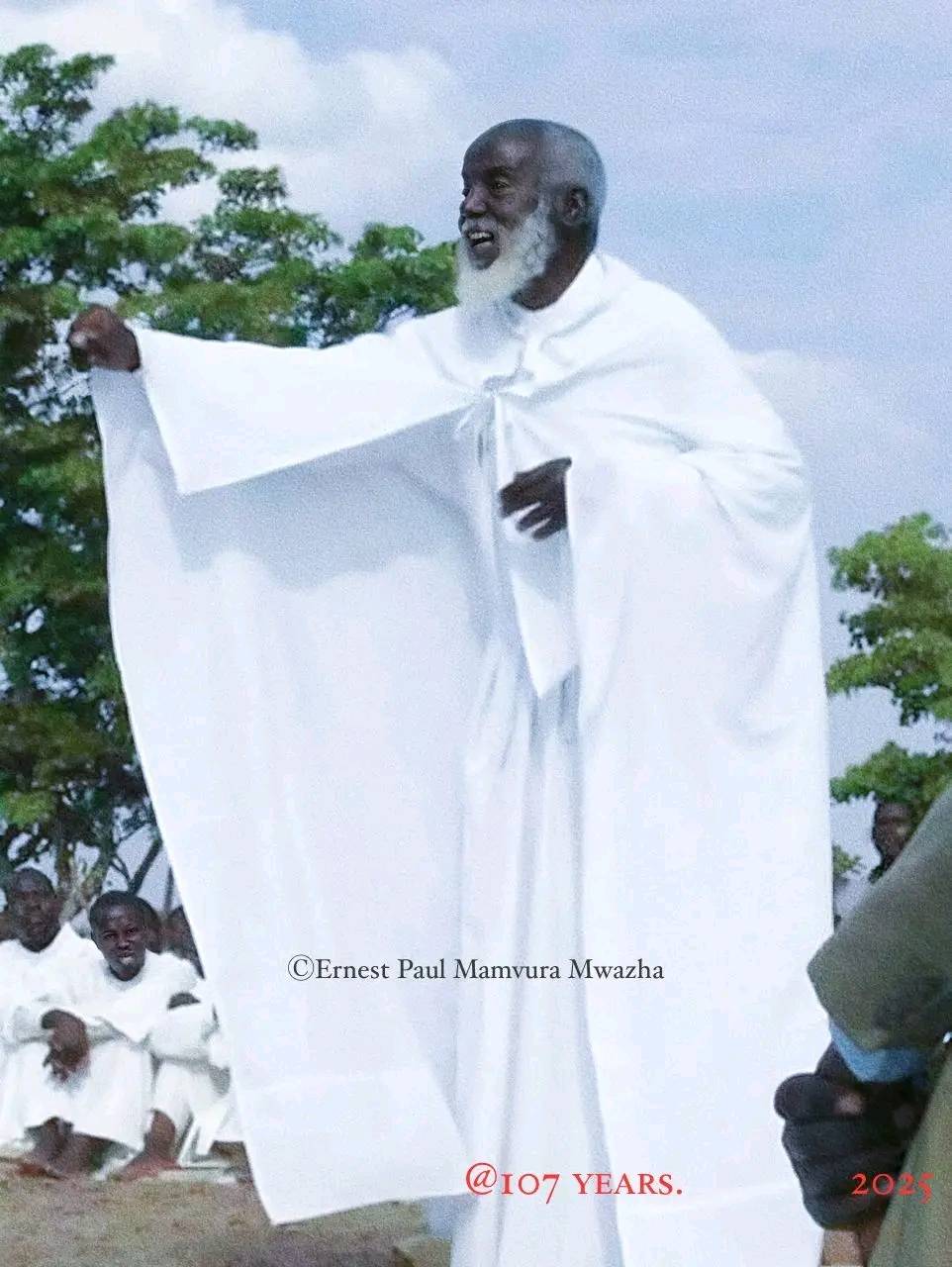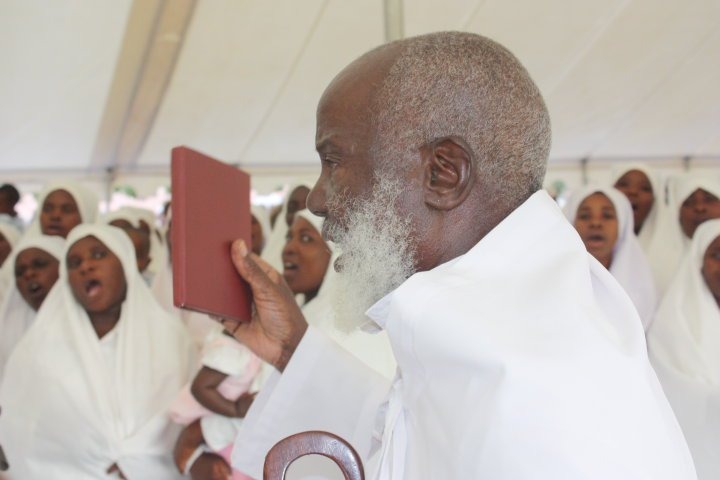
Today, October 25, 2025, marks the 107th birthday of Mutumwa Ernest Paul Mamvura Mwazha, the revered founder and leader of the African Apostolic Church (AAC), commonly known as “VaApostora veAfrica.” As one of Zimbabwe’s oldest citizens, his life spans the entire history of the nation, from colonial Rhodesia to the present day. His legacy is not only one of extreme longevity but also of profound spiritual influence, having established one of the largest African Initiated Churches in the region, with millions of followers.
Early Life and Miraculous Origins
Born on October 25, 1918, at the Holy Cross Mission in the Chirumhanzu District (near Mvuma), Mwazha’s life began with a story that forms a cornerstone of his church’s faith. Named Mamvura by his mother, Saramina, he was born during the height of the devastating 1918 “Spanish Flu” pandemic. According to the church’s foundational accounts, the infant fell gravely ill with influenza and was soon presumed dead. His devout Roman Catholic family took his body to a German missionary, Father Schmidt, for a rushed baptism and last rites before burial. It is reported that immediately after Father Schmidt baptized the child with the name “Paul,” the infant miraculously came back to life. Church history recounts that witnesses were filled with the Holy Spirit and declared, “Mwana amutsirwe basa” (“The child has been raised for a mission”).
This event defined his spiritual trajectory. He was raised in the Catholic faith but later attended a Methodist Church school, eventually training at the Howard Teaching Institute. He became a teacher and a dedicated evangelist within the Methodist Church.
The Divine Commission and Founding the AAC
While serving as a Methodist evangelist, Mwazha reported experiencing profound spiritual visions and calls. The pivotal moment occurred in 1951, when he claims to have received his “divine commission” and heard the voice of the Lord calling him.
This new spiritual direction eventually led to a schism with the Methodist Church. Around 1957-1959, he formally established the African Apostolic Church (AAC). His followers bestowed upon him the title “Mutumwa” (Shona for “The Messenger” or “Apostle”).The church’s core teachings are documented in Mwazha’s founding text, “The Divine Commission of Paul Mwazha of Africa,” which is published in Shona, Ndebele, and English. The AAC blends Christian theology with an emphasis on the power of the Holy Spirit, baptism, prophecy, and adherence to specific church doctrines, including the wearing of white garments for worship.
Growth, Influence, and Recent Challenges
Under his leadership, the AAC grew exponentially from its rural origins to become a massive international church. It now boasts an estimated following of several million people, with major congregations across Zimbabwe, South Africa, Botswana, the UK, and other parts of the diaspora.
Mwazha, who also takes the title “Mudzidzisi” (The Teacher), has remained the central, unifying figure of the church for over six decades. His leadership has been characterized by a modest personal life and a strict adherence to the vows he took when founding the church, such as not trimming his beard.
In recent years, his advanced age has led to significant and highly public challenges. The church has been embroiled in intense succession disputes as different factions, some led by his own sons (who serve as bishops), have battled for control of the church’s future. These disputes have often involved the police and have escalated to the High Court and Supreme Court of Zimbabwe.
In 2021, the Supreme Court had to intervene to reaffirm that Mutumwa Mwazha, despite his frailty, was still the undisputed leader of the church, nullifying attempts by one faction to “retire” him. As he marks his 107th birthday, these factional struggles over his eventual succession remain a defining issue for the church’s stability.